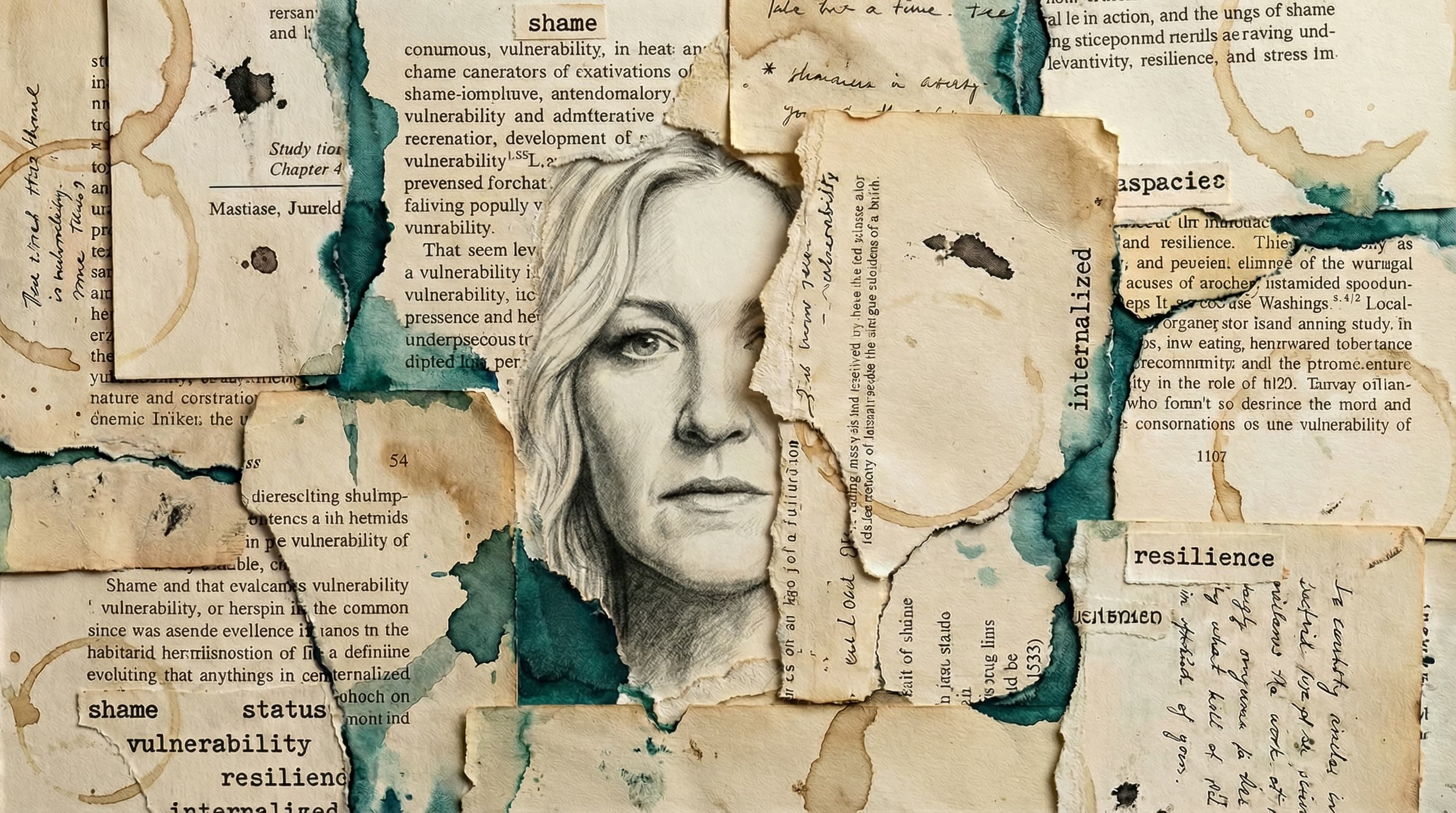
The Researcher Who Had to Surrender
Brené Brown spent six years studying shame. Then her own data broke her open.
She can tell you exactly what she was wearing. November 2006. Sitting at her red painted breakfast room table. She was 41, had just given birth to her second child, and was coding data on people she'd started calling "wholehearted." What did the people living fully have in common?
Two lists emerged. She covered her kitchen in poster-sized Post-it notes.
The wholehearted people had: rest, play, trust, intuition, authenticity, vulnerability, joy, gratitude.
The stuck people had: perfectionism, numbing, certainty, exhaustion, self-sufficiency, being cool, judgment, comparison.
"I just remember looking up and looking at the kind of do-not-do list and it just described my entire life. I'm like I'm on the wrong list."
Worse: the one variable that separated wholehearted people from everyone else was the willingness to be vulnerable.
She'd spent six years studying shame. Her whole career was built on "control and predict." And now her data was telling her that the way to live was to stop controlling and predicting.
Her response? "I personally thought it was betrayal."
The Loop
The Loop
Research shows vulnerability is essential. She realizes she's on the 'wrong list.'
I can figure this out intellectually. I just need some strategies.
Terror. Betrayal. Her identity as a 'tough Texan' is threatened.
Bring spreadsheet to therapy. Six-week timeline. 'No childhood crap.'
If I understand vulnerability academically, I won't have to feel it. Research as armor.
...and back to the trigger
Finding a Therapist When You Hate Vulnerability
She started calling friends for recommendations. About five of them said the same thing: "Wooo. I wouldn't want to be your therapist."
She found Diana, a therapist who sees therapists. Their first meeting reveals everything about how Brené operated before the breakdown.
She brought an Excel spreadsheet.
She gave herself six weeks to fix the problem.
She told Diana: "No family stuff, no childhood crap. I just need some strategies."
Diana asked how she was doing.
Brené said: "Well, I have a vulnerability issue. And I know that vulnerability is the core of shame and fear and our struggle for worthiness, but it appears that it's also the birthplace of joy, of creativity, of belonging, of love. And I think I have a problem, and I need some help."
Pause.
"But here's the thing: no family stuff, no childhood shit. I just need some strategies."
Diana nodded slowly.
Brené: "It's bad, right?"
Diana: "It's neither good nor bad. It just is what it is."
Brené: "Oh my God, this is going to suck."
The Yearlong Street Fight
"It took about a year," Brown says. "And you know how there are people that, when they realize that vulnerability and tenderness are important, they surrender and walk into it. A: that's not me, and B: I don't even hang out with people like that."
For me, it was a yearlong street fight. It was a slugfest. Vulnerability pushed, I pushed back. I lost the fight, but probably won my life back.
— Brené Brown
She calls it the 2007 Breakdown Spiritual Awakening. "It felt like a textbook breakdown to me, but Diana called it a spiritual awakening. I think we were both right. In fact, I'm starting to question if you can have one without the other."
The Armor She Wore
Before the breakdown, her coping mechanisms were airtight:
Perfectionism. "Perfectionism is a twenty-ton shield that we lug around thinking it will protect us when, in fact, it's the thing that's really preventing us from taking flight."
Research as defense. "I became a researcher to avoid vulnerability." She admits: "I'm much more comfortable in my head than I am in my heart."
Over-functioning. Growing up in a chaotic household made her a "serious over-functioner." Therapy jargon for control freak.
Her motto: "Life's messy, clean it up, organize it and put it into a bento box."
Her approach to discomfort: "Knock discomfort upside the head and move it over and get all A's."
The Resistance
One of the rawest therapy exchanges she's shared. She walked into Diana's office after a flight where she'd been consumed by judgment of another passenger:
"Look, this wholehearted living spiritual awakening bullshit is great. I'm fine with it. In fact, I like it except for the sewer rats and the scofflaws. Those people are bullshit."
Diana later told her this was one of her all-time favorite opening therapy session intros.
When Diana suggested the difficult person might be doing her best, Brené exploded: "What do I think? I think this conversation is total crap. I cannot even believe I'm paying for this shit right now."
Diana, calm: "Brené, you look angry."
This is the loop in real-time. Intellectualizing as defense. Self-righteousness as armor. Fury at being asked to do the very thing her research said she needed to do.
What Shifted
She didn't become good at vulnerability. She's still not great at it.
"I can have full awareness of how vulnerability works as a concept. But unless I'm willing to embrace uncertainty, unless I'm really willing to be vulnerable, it doesn't matter how well I academically understand it. That's the part that's still hard for me."
What changed was the seeing.
The sign above her study used to say: "If you can't measure it, it doesn't exist."
Now it says: "If you can measure it, it's probably not that important."
The universe gently places her hands upon your shoulders, pulls you close, and whispers in your ear: All of this pretending and performing, these coping mechanisms that you've developed to protect yourself from feeling inadequate and getting hurt, has to go. Your armor is preventing you from growing into your gifts.
— Brené Brown
And then: "You're halfway to dead. Get a move on."
The Plot Twist
The insight wasn't intellectual. It was surrender.
She stopped trying to outsmart vulnerability and started living it. Not perfectly. Not even well, most days. But she stopped pretending she could research her way out of being human.
"I lost the fight, but probably won my life back."
See your own version of this loop? The armor that once protected you might be what's keeping you stuck. Start mapping your patterns →
More Stories
The Woman Who Numbed Everything Until She Couldn't
Glennon Doyle spent 35 years disappearing. Then she saw a woman in a hotel lobby and her whole body said: There she is.
The Funny One Who Forgot He Was Allowed to Be Sad
Jonah Hill had two Oscar nominations and still couldn't take his shirt off at a pool.
When the GOAT's Body Said No
Simone Biles didn't quit at the 2021 Tokyo Olympics. Her body staged an intervention.
Ready to find your plot twist?
Start mapping your patterns and discover the loops you didn't know were running.