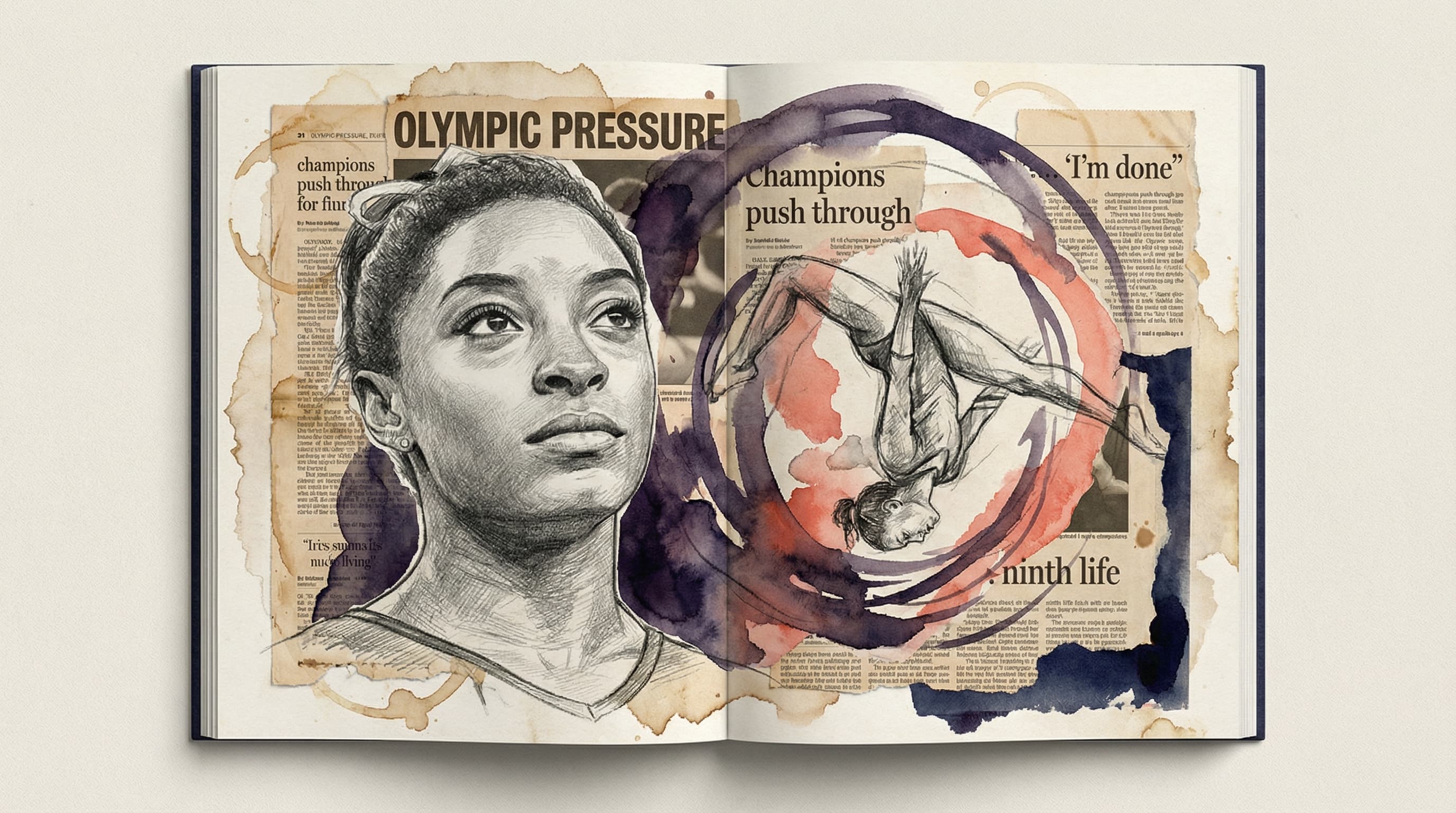
When the GOAT's Body Said No
Simone Biles didn't quit at the 2021 Tokyo Olympics. Her body staged an intervention.
She can tell you the exact moment the wires snapped.
July 27, 2021. Team final vault. Simone Biles launched into the air for a skill she'd performed thousands of times. A 2½ twisting vault. Automatic. Routine.
Except this time, her brain refused to complete the rotation. She landed after only 1½ twists, confused and terrified.
"I had no idea where I was in the air. I could have hurt myself. I had no idea where I was about to land. On my head, my face, my legs, my arms."
She looked at her coach and said something she'd never said before: "I'm done."
The Loop
The Loop
Olympics approaching. Weight of the world. Only Nassar survivor still competing.
Champions push through. You usually don't hear me say things like that because I usually persevere.
Brush it off. Add 'hahaha' to make it seem fine. Minimize distress publicly.
Keep performing. Train harder. Smile bigger. Shove everything in a box.
I can't stop. I thought I was going to be banned from America if not gold.
...and back to the trigger
What Are the Twisties?
Here's how Simone explained it to non-gymnasts:
"Say up until you're 30 years old, you have your complete eyesight. One morning, you wake up, you can't see shit, but people tell you to go on and do your daily job as if you still have your eyesight. You'd be lost, wouldn't you? That's the only thing I can relate it to."
The twisties aren't a mental weakness. They're a neurological survival response. Your brain, overwhelmed by stress, tries to consciously control movements that were previously automatic. The result is motion that's less fluid, less accurate, more dangerous.
In gymnastics, this can be fatal. As former Olympian Dominique Moceanu put it: "In our sport, we essentially dive into a pool with no water. When you lose your ability to find the ground, the consequences can be catastrophic."
It's basically life or death. It's a miracle I landed on my feet. If that was any other person, they would have gone out on a stretcher.
— Simone Biles
The Weight She Was Carrying
The day before her withdrawal, Simone posted on Instagram: "I truly do feel like I have the weight of the world on my shoulders at times. I know I brush it off and make it seem like pressure doesn't affect me but damn sometimes it's hard hahaha!"
That "hahaha" was the mask. Minimize distress publicly while crumbling privately.
She wasn't just competing for herself. She was the only Larry Nassar survivor still on the team. Carrying justice while performing impossible physical feats. When the pandemic postponed Tokyo by a year, it meant another 365 days training in a psychologically toxic environment.
When the New York Times asked what the happiest moment of her gymnastics career had been, Simone answered honestly: "Probably my time off."
She wasn't finding joy anymore. But champions don't quit. Right?
The Beliefs That Kept Her Stuck
Simone carried these beliefs into Tokyo:
"Champions push through." She'd internalized that true competitors never stop. "You usually don't hear me say things like that because I usually persevere and push through things."
"I can't show pain." She believed she had to maintain a facade: "I truly don't understand how I did what I did under those circumstances and how I put on a face."
"My identity is my performance." After Tokyo, she admitted: "I felt like a failure. Even though I was empowering so many people and speaking out about mental health, every time I talked about my experience in Tokyo, it stung."
Her first thought after landing that vault? "Oh, America hates me. The world is going to hate me." She genuinely believed: "I thought I was going to be banned from America, because that's what they tell you: Don't come back if not gold."
The Body's Rebellion
Her body had been sending signals for years. She'd been "brushing off" the pressure with practiced smiles. But everything they'd shoved in a box finally exploded.
"Everything that has happened in my career that we shoved in a box. Your body can only function for so long before your fuses blow out."
In her Netflix documentary, she described what it felt like when the twisties hit:
The sound went out. To me, it felt silent, almost like death.
— Simone Biles
After the vault, she told her coach: "I'm done. I'm not doing any more. Because if I survive that, I don't know how much else I can survive. I always say I'm a cat with nine lives, but I think that was my ninth. I'm done."
The Secret Gym and the Bronze That Meant More
For four days, Simone trained at Juntendo University, an hour outside Tokyo, practicing on soft mats and foam pits. A professor there observed: "She looked like a totally different person. Her movements were not smooth, and she often got frozen."
She posted videos of herself crashing into landing pads with a message for critics: "I don't think you realize how dangerous this is on hard surface. Nor do I have to explain why I put my health first. Physical health is mental health."
Then she came back for the balance beam final. But different. She removed all twisting elements. Changed her dismount to a skill she hadn't competed since age twelve.
She won bronze.
And it meant more than any gold: "It definitely feels more special, this bronze, than the balance beam bronze at Rio. I will cherish it for a long time."
The insight crystallized: "I just did this for me and me only. I wasn't expecting to walk away with a medal."
The Messy Middle
The comeback wasn't linear. Simone didn't resume serious training for about eighteen months. She committed to weekly therapy every Thursday, a practice she calls "religious."
In October 2021, she told the TODAY show with tears: "The twisting once I got back will come back, but I'm still scared to do gymnastics."
In her Netflix documentary, she revealed the dark period: "This is the forbidden Olympic closet. I never really come in this room. I used to sit here and just cry and cry and cry. Ask God why this happened to me."
When she finally told her coaches she wanted to return, they said no at first: "They were kind of like, 'Get back in the gym. Get your skills back. Let's see if you actually want to do this.'"
Paris 2024: Redemption Through Boundaries
Biles returned at the 2023 World Championships. Won four gold medals. Became the most decorated gymnast in World Championships history.
But Paris 2024 was the real test.
She implemented strict boundaries. Missed cherished family Sunday dinners. ("I just didn't have that much energy to give.") Avoided social media entirely. Continued virtual therapy with her U.S. therapist, who woke in the middle of the night to accommodate time zones. She had a therapy session the morning of the Paris team final.
The fear of the twisties never fully disappeared. "I thought about that every single day," she admitted, "but not in a negative way. It was in a more positive way, that I've put the work in and that this will not happen again."
Paris delivered four medals: team gold, individual all-around gold, vault gold, floor exercise silver. After vault (the event that triggered her Tokyo withdrawal), she said: "I've been anticipating this day for a really long time, and it was one of my biggest motivators to get back here."
What Actually Changed
The shift wasn't physical. It was a complete rewriting of her belief system.
Before Tokyo: "Everybody defined success for me, even though I had my own narrative."
After: "Now, it's about showing up, being in a good mental space, having fun, and letting whatever happens happen."
She separated her identity from gymnastics: "Gymnastics is something that I do and it's not who I am as a person. I think it took years to realize that."
Her motivation for returning wasn't validation. It was avoiding regret: "I never want to look back in ten years and say, 'What if I could have done another Olympic cycle?' I at least tried."
And: "I didn't want to be afraid of the sport anymore because so much has happened in this sport, so much has scared the living shit out of me that I couldn't have it take that one last thing from me."
The Plot Twist
Simone's body refused to cooperate when her mind kept demanding more. It forced a reckoning with years of suppressed trauma, impossible expectations, and beliefs about champions that nearly destroyed her.
I'm more than my accomplishments and gymnastics, which I never truly believed before.
— Simone Biles
Looking back, she frames Tokyo not as a failure but as the catalyst: "I wouldn't change anything for the world. I think everything happens for a reason."
What she learned: "Courage, resilience, how to say no and speak up for yourself."
Those skills, not the vault or the beam, became the foundation for everything that followed.
See your own version of this loop? Sometimes our bodies know what our minds refuse to accept. Start mapping your patterns →
More Stories
The Woman Who Numbed Everything Until She Couldn't
Glennon Doyle spent 35 years disappearing. Then she saw a woman in a hotel lobby and her whole body said: There she is.
The Funny One Who Forgot He Was Allowed to Be Sad
Jonah Hill had two Oscar nominations and still couldn't take his shirt off at a pool.
The Researcher Who Had to Surrender
Brené Brown spent six years studying shame. Then her own data broke her open.
Ready to find your plot twist?
Start mapping your patterns and discover the loops you didn't know were running.