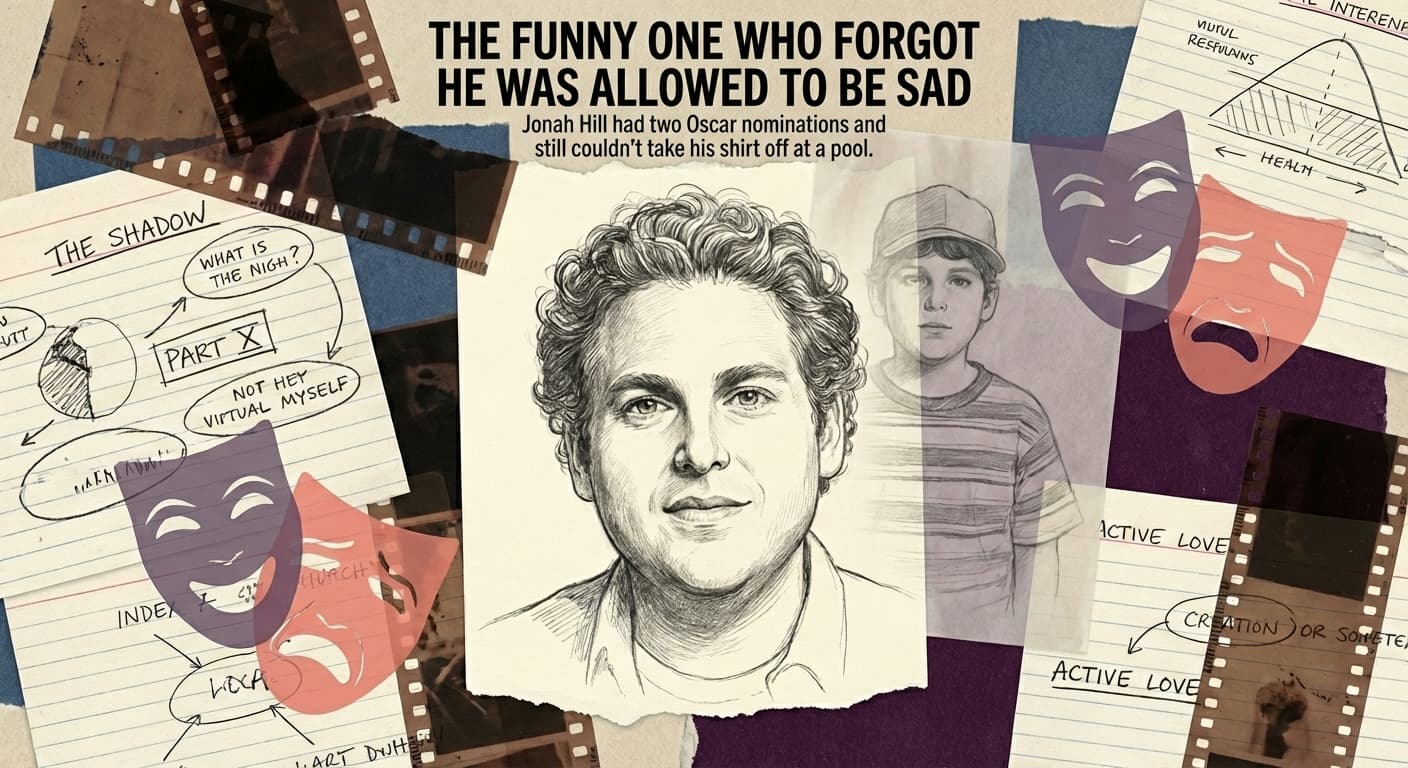
The Funny One Who Forgot He Was Allowed to Be Sad
Jonah Hill had two Oscar nominations and still couldn't take his shirt off at a pool.
He learned early that entertainment was his currency.
"I was an insecure, overweight kid," Hill told GQ. "You are a target for abuse."
So he found a workaround. If you make people laugh, they let you stay. If you throw yourself down ten stairs, they forget you can't land a trick. If you're brutal enough to yourself, nobody else has to be.
I would be brutal to myself, or allow brutality to me, because I felt like that was my seat at the table.
— Jonah Hill
It worked. Superbad. Knocked Up. Moneyball. The Wolf of Wall Street. Two Academy Award nominations by age 30. The sharp-tongued, foul-mouthed fat kid had made it.
Except making it didn't fix anything.
"I'm this wildly insecure kid, and I think success and awards will absolve me of the pain of life. So I work so hard to get there, and because of my privilege and luck, I got to go into that Snapshot relatively early. And when it didn't cure any of that stuff, it made me beyond depressed."
The Loop
The Loop
Fat kid in skateboarding and comedy. You are a target for abuse.
If you make someone laugh you are making them happy. I should keep doing that.
Fear of rejection. Deep belief he's unlovable as-is. Must earn his seat.
Perform / self-destruct. Be brutal to yourself. Allow brutality.
Success will fix it. I think success and awards will absolve me of the pain of life.
...and back to the trigger
The Seat at the Table
Hill grew up in Santa Monica, the middle child of a costume designer and a tour accountant for Guns N' Roses. He went to an elite private school. He worked at a skate shop. On paper, a comfortable life.
But he was the fat kid. And both skateboarding and comedy, he says, are "the two gnarliest environments." If you don't fit, you find another way in.
"I guess it was just what I was good at. Entertaining, writing, being funny. If you make someone laugh you are making them happy. You immediately think, that's good. If I'm making people happy I should keep doing that."
The logic is airtight. And completely self-erasing.
He dropped out of college and became famous as a teenager. Years later, he realized what he'd missed: "Those four years gave all my friends this wobbling period of how to be a person. I was really advanced professionally but really behind personally. All my 20s, I wasn't really looking inward. I was just running toward success."
The Body That Wouldn't Cooperate
The public never let him forget his weight.
At the 2012 Oscars, where Hill was nominated for Moneyball, the host made a joke about his weight loss and promised cupcakes after the show if he lost. The camera cut to Hill as Brad Pitt and Martin Scorsese laughed.
During the Wolf of Wall Street press tour, an interviewer asked: "Are you still considered 'the fat guy'?" Hill's response: "Do you have any other questions that are smart?"
But the deeper wound came from childhood.
In Stutz, Hill confronts his mother Sharon on camera. He explains how her efforts to address his weight when he was young—taking him to doctors, reinforcing that something was wrong with how he looked—shaped everything.
It immediately put you in the position of being adversarial. Like, 'This is the person that doesn't accept me.' I felt like no female would ever accept me as I am.
— Jonah Hill
Sharon reveals her own history: she was "the larger one" in her family, told by her mother and sister to lose weight. The pattern didn't start with Jonah.
"When I was a kid, exercise and diet was framed to me as like, 'There's something wrong with how you look,'" Hill says. "But never once was exercise or diet propositioned to me in terms of mental health."
The result: "I avoided exercise into adulthood because of how it served as a reminder I was overweight growing up."
Meeting Stutz
Around 2016, Joaquin Phoenix recommended his psychiatrist to Hill. Phil Stutz was in his 70s, a former prison psychiatrist at Rikers Island who'd grown frustrated with traditional therapy. He used hand-drawn notecards. He gave patients tools instead of years of analysis.
The first thing Stutz told Hill: "You're not a good artist because you're fucked up. You're a good artist in spite of being fucked up."
It's all a dumb mythology that you're supposed to be miserable to be talented. I got healthier, my art got better, and I was happier. Straight up.
— Jonah Hill
Stutz's framework is built on three unavoidable realities: pain never goes away, uncertainty never goes away, and the need for constant work never goes away. The goal isn't to escape these. It's to change your relationship with them.
One of his core concepts is Part X, the internal saboteur. "It doesn't want you to have any kind of forward motion," Stutz explains. "It wants to render your life a failure. It wants you to never reach your potential. And it wants you to hate yourself, which is the biggest thing."
You can defeat Part X temporarily. But it keeps coming back.
The Shadow
Stutz calls it The Shadow: the part of yourself you're ashamed of. The version you wish didn't exist.
In one of the documentary's most striking moments, Hill brings out a life-size cardboard cutout of himself at age 14. Overweight. Acne-covered. Defeated.
"A 14-year-old boy who's very overweight and has acne and feels very undesirable to the world," Hill says, holding it.
Stutz looks at the cutout and says: "You can come home with me."
The exercise isn't about erasing the Shadow. It's about welcoming it. The 14-year-old who performed for approval is still in there. He just needed someone to tell him he could stay without earning it.
The Day Everything Broke
On December 22, 2017, Hill's older brother Jordan died suddenly at age 40 from a pulmonary embolism. Jordan was Maroon 5's manager, a childhood friend of Adam Levine. He was the oldest of the three Feldstein siblings.
Hill went straight to Stutz's office that day. In an unconventional move, Stutz asked for Hill's phone and took a photograph of him in that moment of raw grief.
Hill avoided looking at the photo for four years.
In one of the documentary's most devastating sequences, he finally looks at it on camera.
"I spend a lot of my life avoiding thinking about that day. It was definitely the most intense day in my life."
Then, studying the image: "I look stripped of everything fake. And there is an oddly serene look on my face which is so bizarre, but maybe because it demolished everything that didn't matter."
The documentary is dedicated to both of their brothers.
The Shirt Comes Off
In February 2021, the Daily Mail published paparazzi photos of Hill surfing shirtless in Malibu. His Instagram response went viral:
"I don't think I ever took my shirt off in a pool until I was in my mid-30s even in front of family and friends. Probably would have happened sooner if my childhood insecurities weren't exacerbated by years of public mockery about my body by press and interviewers."
"So the idea that the media tries to play me by stalking me while surfing and printing photos like this and it can't phase me anymore is dope. I'm 37 and finally love and accept myself."
This isn't a 'good for me' post. And it's definitely not a 'feel bad for me post.' It's for the kids who don't take their shirt off at the pool. Have fun. You're wonderful and awesome and perfect.
— Jonah Hill
Eight months later, he posted a simpler boundary: "I know you mean well but I kindly ask that you not comment on my body. Good or bad I want to politely let you know it's not helpful and doesn't feel good."
Stepping Back
In August 2022, Hill released an open letter that surprised the industry:
"I have come to the understanding that I have spent nearly 20 years experiencing anxiety attacks, which are exacerbated by media appearances and public facing events."
"You won't see me out there promoting this film, or any of my upcoming films, while I take this important step to protect myself."
He acknowledged his privilege directly: "I am of the privileged few who can afford to take time off. I won't lose my job while working on my anxiety."
His You People co-stars supported him publicly. Julia Louis-Dreyfus: "You have to protect yourself and do what feels right to you."
Hill deleted his Instagram and has maintained a low public profile since. He's still working. He's just not performing.
What Actually Changed
The shift wasn't that Hill stopped experiencing pain or anxiety. It was his relationship to them.
His practices expanded: transcendental meditation, Brazilian jiu-jitsu, surfing. "Two things that if you are not present you will literally get fucked up," he said about jiu-jitsu and surfing. "You will definitely get choked out if you think about something you did two years ago that you're bummed about."
The man who performed for approval learned to set boundaries. The kid who threw himself down stairs learned he was allowed to protect himself. The actor who couldn't take his shirt off finally surfed in Malibu while paparazzi photographed him—and posted the photos himself.
"I feel like I spent my whole 20s trying to be what people wanted me to be, and I didn't know who I was. And the past couple years have been amazing, in the way of like, I'm just going to be myself."
The Plot Twist
Hill's story isn't about curing anxiety or finally becoming thin enough or successful enough. It's about recognizing that the seat at the table was never conditional.
The secret of life is accepting that you won't figure it out, ever. And nobody else will figure it out, ever. Happiness depends on how you accept that and what you do about it.
— Phil Stutz
The funny one who forgot he was allowed to be sad finally remembered. And then he made a movie about it.
See your own version of this loop? Sometimes the role we play to belong becomes the thing that keeps us from ourselves. Start mapping your patterns →
More Stories
The Woman Who Numbed Everything Until She Couldn't
Glennon Doyle spent 35 years disappearing. Then she saw a woman in a hotel lobby and her whole body said: There she is.
When the GOAT's Body Said No
Simone Biles didn't quit at the 2021 Tokyo Olympics. Her body staged an intervention.
The Researcher Who Had to Surrender
Brené Brown spent six years studying shame. Then her own data broke her open.
Ready to find your plot twist?
Start mapping your patterns and discover the loops you didn't know were running.